
Handwrytten Notes vs Print Cards: Why Personalization Matters

In a world of mass-produced everything, the handwritten word still stops people in their tracks.

Walk into any card shop and you’ll find hundreds of options — beautifully designed, professionally printed, and completely interchangeable. The sentiment is pre-written. The message is generic. And the person receiving it knows, on some level, that the effort involved was choosing it from a rack and signing their name at the bottom.

That’s not a criticism of print cards. For casual occasions, they serve their purpose. But when the goal is to make someone feel genuinely valued — a client whose business you want to keep, a customer whose loyalty you’ve earned, a relationship worth investing in — a mass-produced card has a ceiling. It can be pleasant. It can’t be personal.

That’s the core of the Handwrytten notes vs. print cards question, and it’s worth examining closely — especially for businesses that depend on the quality of their client relationships to drive retention, referrals, and long-term growth.
The Personalization Gap

The most fundamental difference between handwritten notes and print cards isn’t aesthetic — it’s the signal each one sends.

A print card communicates: I thought of you enough to pick something out.

A handwritten note communicates: I thought about what to say to you specifically, and I wrote it down.

That distinction is felt by the recipient whether they consciously register it or not. Personalization isn’t just a feature of handwritten communication — it’s the entire point. And the gap between a message that feels tailored and one that feels templated is wider than most businesses realize.

With Handwrytten, every note is written with a real pen on real paper, with a message customized for the individual recipient. That’s not a simulation of personalization — it’s the real thing, produced at scale.


Engagement: What Actually Gets Read, Kept, and Remembered

Print cards get opened. Handwritten notes get kept.

There’s a meaningful difference between a card that gets glanced at and recycled and one that ends up propped on a desk, pinned to a bulletin board, or tucked into a drawer as a reminder that someone took the time. Handwritten notes consistently land in the second category — and that staying power is what drives the downstream effects businesses care about: brand recall, emotional loyalty, and the likelihood of a referral conversation.

The mechanics behind this aren’t complicated. Handwriting signals effort. Effort signals value. And when a recipient feels valued by a brand, they behave differently — they stay longer, spend more, and tell more people.

For businesses, the comparison between handwritten notes vs. print cards isn’t really about aesthetics. It’s about which one produces better outcomes over time.

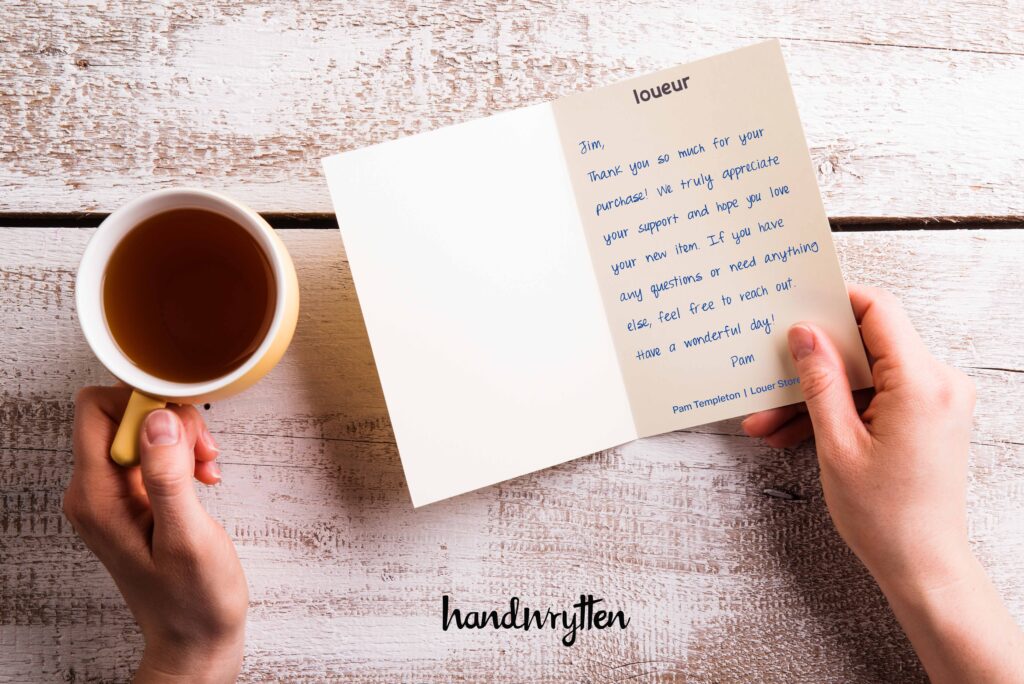
Handwrytten cards with actual handwritting


Scalability: The Advantage That Changes the Equation

The traditional objection to handwritten outreach is an obvious one: it doesn’t scale. You can’t hand-write a personalized note to every client, every month, without it consuming your entire team’s bandwidth.

Print cards solved the scale problem — but at the cost of the personal quality that made the gesture worth sending in the first place. Handwrytten solves both simultaneously.

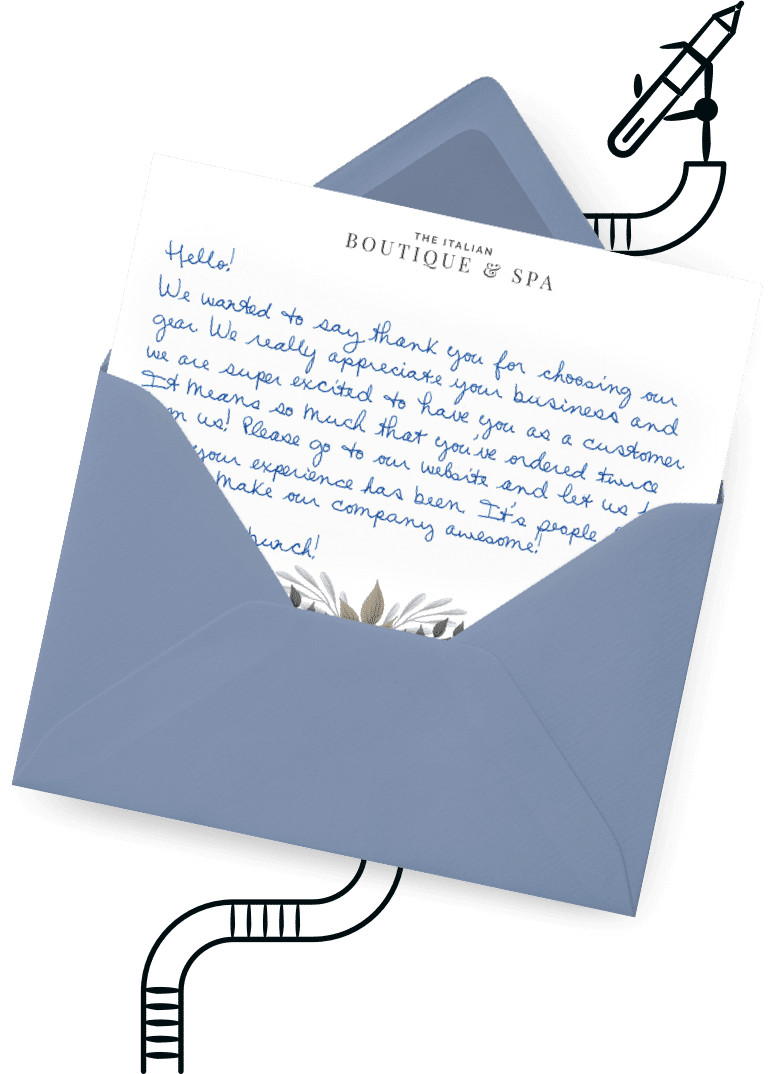
Using robotic pen-and-ink technology, Handwrytten produces genuinely handwritten cards — not printed approximations — at any volume. A campaign of ten cards looks and feels identical to a campaign of ten thousand. Each one is written with real ink on real paper, personalized with the recipient’s name and a message tailored to them, addressed, stamped, and mailed without any manual effort from your team.

That’s the equation that tips the handwritten notes vs. print cards comparison decisively in one direction for serious business use: the personal quality of handwriting, at the operational scale of print.


Speed and Reliability

One of the practical advantages print shops have traditionally held over handwritten alternatives is turnaround time. Custom print orders can take days or weeks to process, proof, print, and ship — which makes time-sensitive outreach difficult to execute well.

Handwrytten eliminates that constraint. Cards are produced and mailed within one to two business days, with domestic delivery in three to seven business days. For campaigns tied to specific dates — a client anniversary, a post-meeting follow-up, a seasonal touchpoint — that reliability matters.

Consistency matters too. Every card produced through Handwrytten is written neatly and uniformly, regardless of volume. There’s no variation in quality between card one and card one thousand.

Handwrytten cards with actual handwritting


Handwriting Styles and Custom Fonts

One of the more underappreciated features in the handwritten notes vs. print cards comparison is the flexibility Handwrytten offers around handwriting style itself.

Choose from dozens of realistic handwriting styles — ranging from neat and professional to warm and casual — to match the tone of your brand and message. Or go further: create a custom font based on your own actual handwriting, so every card that goes out looks like it came directly from you, regardless of who on your team placed the order.

For businesses with multiple team members sending cards — sales reps, account managers, executives — this means every card can carry the signature handwriting style of the person it’s ostensibly from. That level of consistency and authenticity is simply not available through traditional print.


The Business Case: What Personalization Actually Produces

The handwritten notes vs. print cards debate ultimately comes down to outcomes. Here’s what the research and real-world experience consistently show for businesses that invest in handwritten outreach:

Higher client retention. Clients who receive personalized, handwritten communication feel more valued — and clients who feel valued stay longer. The emotional connection that handwriting creates translates directly into reduced churn.

Stronger brand loyalty. Repeat customers and long-term clients are disproportionately likely to have had positive, memorable experiences with a brand beyond the transaction itself. A handwritten note is one of the most efficient ways to create those experiences.

More referrals. Word-of-mouth referrals are driven by emotion, not logic. Clients who feel genuinely appreciated are significantly more likely to recommend a business to someone in their network — and a handwritten card is one of the most reliable ways to create that feeling at scale.

Better brand recall. A card sitting on a desk keeps your brand in the recipient’s physical environment in a way no email ever could. That passive, persistent visibility compounds over time.


Handwrytten Notes vs. Print Cards: A Direct Comparison

Handwritten Notes Print Cards
Personalization Fully customized per recipient Generic or lightly personalized
Emotional impact High — signals genuine effort Moderate — functional but expected
Memorability Often kept and displayed Frequently discarded after reading
Scalability Yes, with Handwrytten Yes, but at the cost of personalization
Turnaround 1–2 business days Days to weeks depending on printer
Handwriting styles Dozens of options, custom fonts available Not applicable
Business outcomes Higher retention, loyalty, referrals Lower engagement over time


Frequently Asked Questions

Are handwritten notes really more effective than print cards for business use? Consistently, yes. Handwritten notes produce stronger emotional responses, higher brand recall, and better downstream outcomes — retention, referrals, repeat purchases — than generic print cards. The personalization gap between the two formats is felt by recipients and reflected in results.

How does Handwrytten make handwritten outreach scalable? Handwrytten uses robotic pen-and-ink technology to produce genuinely handwritten cards at any volume — each one personalized for the individual recipient, produced with real ink on real paper, and mailed without manual effort. The scale of print with the quality of handwriting.

Can I use my own handwriting style? Yes. Handwrytten allows you to create a custom font based on your actual handwriting, so every card sent through the platform looks like it came directly from you — regardless of volume.

How quickly are cards produced and delivered? Cards are typically produced and mailed within one to two business days, with domestic delivery in three to seven business days. International timelines vary by destination.

Is handwritten outreach cost-effective for businesses? Yes. Handwrytten offers scalable pricing designed for business use — and when measured against the client retention, referral, and loyalty outcomes it produces, the return on investment consistently justifies the cost.


When the goal is genuine connection — the kind that keeps clients loyal, generates referrals, and builds a brand people remember — the Handwrytten notes vs. print cards comparison isn’t particularly close. One is a gesture. The other is a strategy.

Start Sending → handwrytten.com

Editor’s note: This article was revised in May 2026

Choose from our cards design or your own.

Over 100 designs to choose from or design your own. Our online card customizer makes it simple.

Check Out Our Cards!

Next Posts

Streamlining Address Collection with Handwrytten’s New Features

Workplace Gratitude: How to Appreciate Your Team This Holiday Season

What are you searching for?

Still need help?
Send us a note.

    Thank you.

    This website uses cookies to improve your experience.
    We'll assume you're ok with this, but you can opt-out if you wish.