


Donors don’t give once and disappear. They give again — to the organizations that make them feel like their contribution genuinely mattered.
Nonprofit stewardship is the practice of nurturing donor relationships beyond the initial gift — and it’s the single most underleveraged strategy in most organizations’ fundraising operations. The average nonprofit spends the majority of its development resources on donor acquisition: campaigns, events, appeals, digital outreach. Far fewer invest proportional effort in what happens after a donation is received — in the ongoing communication, acknowledgment, and relationship-building that determines whether a first-time donor becomes a recurring one, a recurring donor becomes a major one, and a major donor becomes a lifelong advocate.
The numbers tell the story clearly. Donor retention rates across the nonprofit sector hover around 40 to 45% — meaning most organizations lose more than half their donors every year, and then spend significant resources replacing them. The most direct investment in improving that number isn’t a new acquisition campaign. It’s a smarter nonprofit stewardship strategy that makes every donor feel genuinely seen, specifically appreciated, and personally connected to the mission they’re supporting.
Handwritten cards are the most effective format for delivering that experience — personal, physical, and impossible to mistake for automated mass communication. This guide covers the complete nonprofit stewardship card strategy: how to segment your donors, what to send at each stage of the donor journey, how to time your outreach for maximum impact, and how to build a program that runs consistently without overwhelming your development team.
In a sector where digital communication has become the default — email acknowledgments, automated receipts, e-newsletters, social media updates — a handwritten card arrives as something genuinely different. It signals that a real person at this organization took specific time for this specific donor. That signal communicates genuine individual attention in a way that no digital message can replicate — and in the context of nonprofit stewardship, where the relationship between donor and organization is fundamentally personal, that distinction matters enormously.
Donor stewardship cards that arrive in physical, handwritten format create emotional impressions that persist long after a digital acknowledgment would have been forgotten. Recipients hold them, read them carefully, and often keep them. The feeling they create — of being genuinely seen and specifically appreciated by an organization whose mission they care about — is what converts a transactional gift into an emotional commitment to a cause.
That emotional commitment is the foundation of donor retention, major gift development, and the legacy giving conversations that represent the highest-value outcomes in nonprofit stewardship. And handwritten cards are the most reliable format for building it — at every stage of the donor journey, across every segment of the donor base.
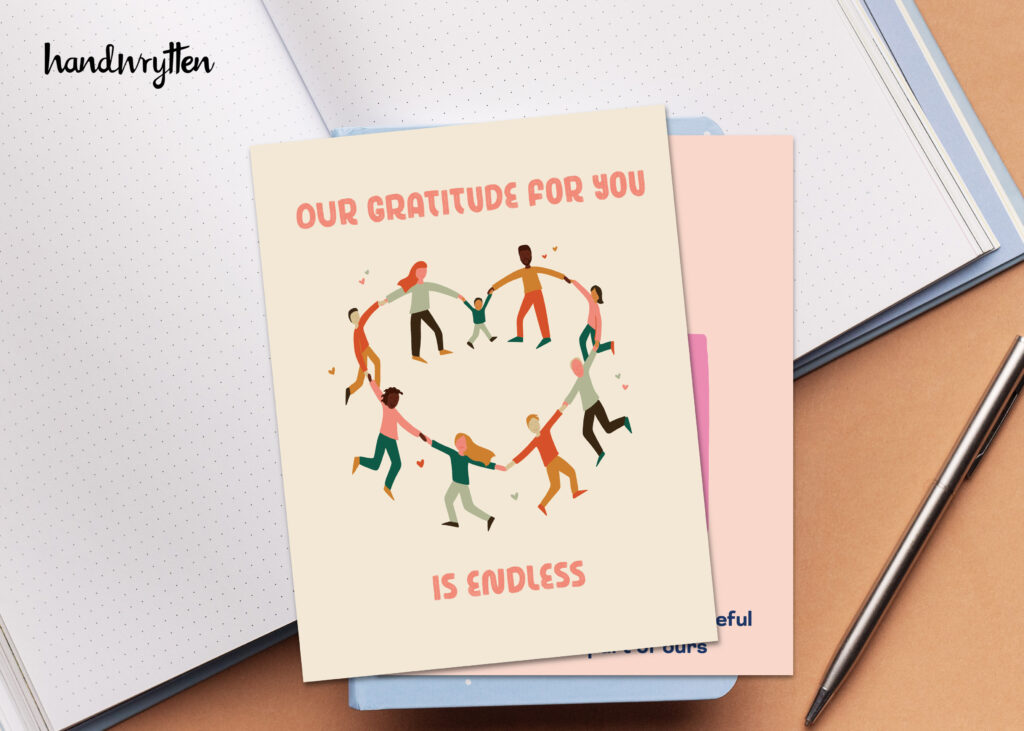
Effective nonprofit stewardship doesn’t happen at a single moment — it happens across the full arc of a donor’s relationship with your organization. Before choosing card designs or writing messages, map the specific moments in your donor journey where a handwritten card would create the strongest impression.
First-time gift acknowledgment. The most critical moment in the entire nonprofit stewardship calendar. A first-time donor is deciding, in the days after their initial gift, whether this organization is worth a long-term relationship. A handwritten card acknowledging their first gift specifically — arriving within 48 hours of the donation — creates the relational foundation that makes everything subsequent more likely.
Recurring donor milestones. A donor who has given monthly for six months, one year, or five years has demonstrated a level of commitment that deserves specific, individual acknowledgment. Most nonprofits never send a milestone card to recurring donors — which means the ones that do create a disproportionately strong impression.
Major gift recognition. Major donors require a level of nonprofit stewardship that goes significantly beyond standard acknowledgment. A handwritten card from senior leadership — specific, personal, and expressing genuine appreciation for the scale of the commitment — communicates the individual attention that major donors both deserve and expect.
Volunteer appreciation. Volunteers are the most frequently overlooked segment in nonprofit stewardship — and the ones for whom a genuine personal acknowledgment creates some of the most lasting loyalty. A handwritten card to a volunteer expressing specific appreciation for their time and effort communicates something most volunteers never receive.
Event follow-up. Donors and supporters who attend events — galas, fundraisers, community gatherings — are at their highest level of emotional engagement with the organization in the days immediately following the event. A handwritten follow-up card arriving within a week of the event captures that engagement at its peak.
Lapsed donor re-engagement. Donors who have stopped giving are rarely lost permanently — they’re often simply waiting for a reason to reconnect. A warm, personal handwritten card with no ask attached is one of the most effective re-engagement tools available, arriving as a genuine gesture of ongoing appreciation rather than a solicitation.
Legacy donor cultivation. Planned giving conversations begin with the deepest level of relationship trust — and nonprofit stewardship programs that have consistently delivered genuine, personal acknowledgment throughout the donor relationship create the trust foundation that makes legacy conversations feel natural rather than transactional.
Effective donor stewardship cards require segmentation — because the message that resonates with a first-time donor is fundamentally different from the one that lands with a decade-long major donor, and sending the same generic message to both signals that the organization isn’t paying the individual attention its nonprofit stewardship program is supposed to communicate.
New donors. First gift within the past 90 days. Nonprofit stewardship priority: make the emotional case for a second gift by creating a genuinely warm first impression. Messages should be specific about the impact of the first gift and genuinely welcoming to the relationship.
Recurring monthly donors. Giving consistently on a monthly basis. Nonprofit stewardship priority: acknowledge the consistency and commitment that monthly giving represents — not just the cumulative amount. Messages should honor the ongoing nature of the commitment and mark milestones as they occur.
Major donors. Giving at a threshold that places them in the top tier of your donor base. Nonprofit stewardship priority: individual, high-touch acknowledgment from senior leadership that reflects the scale of the relationship. Messages should be specific, personal, and written by or appearing to come from the most senior relevant leader.
Volunteers. Contributing time rather than funds. Nonprofit stewardship priority: genuine, specific appreciation for the specific contributions they make. Messages should acknowledge what they actually do rather than expressing generic volunteer gratitude.
Corporate sponsors. Giving at the organizational level. Nonprofit stewardship priority: professional warmth that acknowledges the partnership between organizations rather than between individuals. Messages should recognize the specific sponsorship and its impact.
Lapsed donors. Previously gave but haven’t given in the past 12 to 18 months. Nonprofit stewardship priority: warm, no-pressure re-engagement that communicates continued appreciation without any solicitation. Messages should focus entirely on the ongoing value of the relationship rather than on the lapsed gift.
Consistency is the quality that separates a nonprofit stewardship program that builds lasting donor loyalty from one that produces occasional nice moments. A systematic card calendar — identifying which segments receive which donor stewardship cards at which moments throughout the year — is what makes consistency possible without overwhelming your development team.
A practical nonprofit stewardship card calendar:
January — New Year impact update. A card to all active donors sharing the impact of the previous year’s giving — specific, mission-connected, and expressing genuine gratitude for what their collective support made possible.
“As a new year begins, we’re reflecting on what the past year’s generosity made possible — and your support is a significant part of that story. Here’s to everything we’ll accomplish together in the year ahead.”
April — Volunteer Appreciation Week. A dedicated handwritten card to every active volunteer expressing specific, genuine appreciation for their time and contribution.
“Volunteer Appreciation Week felt like exactly the right moment to reach out personally and say: what you give to this organization goes far beyond the hours. Thank you — genuinely.”
June — Mid-year impact card. A mid-year donor stewardship card to recurring and major donors sharing a specific mid-year impact update — connecting their ongoing giving to concrete outcomes.
“Halfway through the year and the impact your support has made is already significant. We wanted to reach out personally to share what’s been accomplished and to express how grateful we are for your continued commitment.”
August — Mission-specific seasonal card. A card tied to a specific seasonal moment relevant to your mission — back-to-school for education nonprofits, summer programming wrap-up for youth organizations, seasonal need acknowledgment for food banks and shelters.
“As summer winds down, we’re thinking about the students whose school year will look different because of supporters like you. Thank you for making that difference possible.”
November — Thanksgiving appreciation card. The most important seasonal touchpoint in the nonprofit stewardship calendar — arriving before the year-end giving season with pure appreciation and no ask attached.
“This Thanksgiving, we’re reflecting on the generosity that makes our work possible — and your name comes to mind with genuine gratitude. Thank you for everything. Happy Thanksgiving.”
December — Holiday card with year-end impact. A warm, mission-connected holiday card expressing gratitude for the year and communicating genuine enthusiasm for what lies ahead — distinct from any year-end appeal, which should arrive in a separate communication.
“As the year closes, we’re filled with gratitude for every person who made this year’s impact possible. You are one of those people. Thank you — and wishing you a wonderful holiday season.”
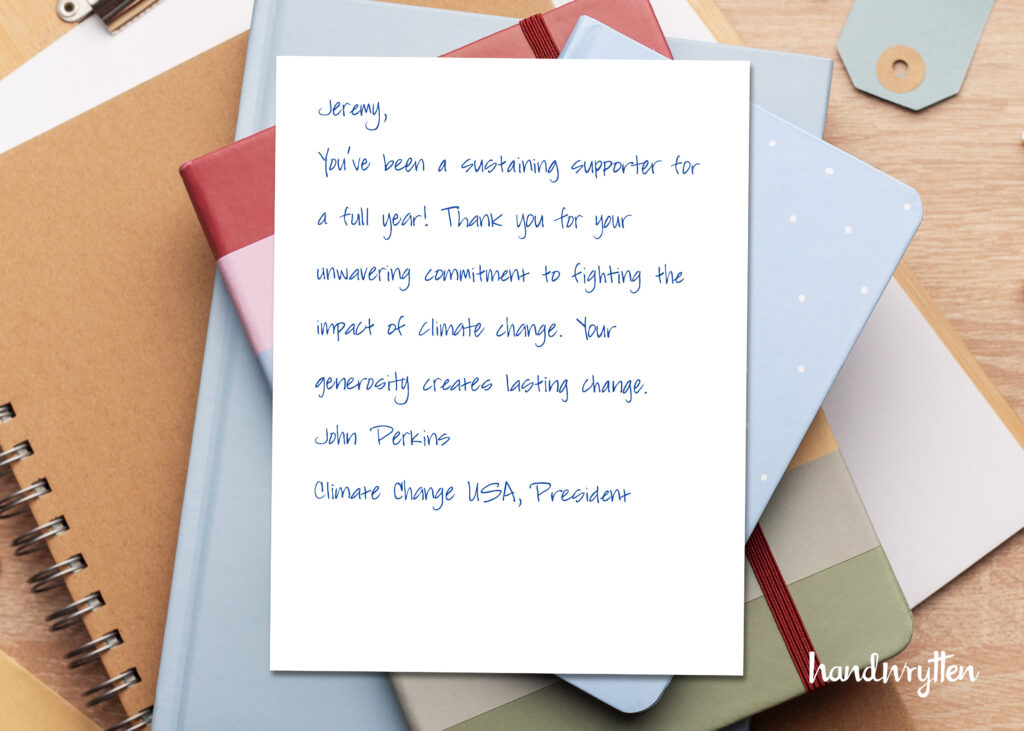
The nonprofit stewardship card messages that create lasting impressions share a consistent set of qualities — regardless of the segment they’re written for or the moment in the donor journey they’re addressing:
Specificity over generality. A message that references the specific program a donor supported, the specific milestone they’ve reached, or the specific contribution they’ve made communicates genuine individual attention. Generic gratitude — however warmly expressed — communicates the opposite.
Mission connection over organizational language. The message that resonates with a donor isn’t about the organization’s gratitude — it’s about the mission impact their giving made possible. Connect every nonprofit stewardship message to a specific, human outcome where possible.
Brevity over elaboration. Three to five sincere sentences outperform a full page of warm but general language every time. Donor stewardship cards are intimate by format — they should feel like personal messages, not institutional communications.
Sample donor stewardship card messages by segment:
First-time donor:
“Thank you for your first gift to [Organization] — it means more than a standard acknowledgment can express. What you’ve made possible with this contribution is [specific impact], and we’re genuinely grateful you’ve chosen to be part of what we do.”
Recurring donor anniversary:
“One year of monthly giving — and we want to make sure you know how much that consistency means. Your ongoing commitment to [cause] creates the kind of sustained impact that one-time gifts simply can’t. Thank you for a full year of genuine partnership.”
Major donor:
“A gift of this significance represents a level of commitment to [mission] that we don’t take lightly. Your support will make [specific outcome] possible — and we wanted to express our genuine, personal gratitude in a format that reflects the weight of that commitment. Thank you.”
Volunteer:
“What you bring to [Organization] every [day/week/month] goes far beyond the hours you give. The way you [specific contribution] makes a difference that our data will never fully capture. Thank you for being the kind of supporter who shows up — reliably, generously, and with genuine care.”
Lapsed donor:
“It’s been a while since we’ve been in touch, and we wanted to reach out personally — not to ask for anything, but simply to say that your past support is remembered with genuine gratitude. The door is always open whenever the timing feels right. Thank you.”
Corporate sponsor:
“The partnership between [Company] and [Organization] has made [specific impact] possible this year — and we wanted to acknowledge that directly and personally. Your organization’s commitment to [mission] is something we’re genuinely grateful for. Thank you.”
Donor stewardship cards should feel like an extension of your organization’s visual identity — not a generic seasonal card that could have come from any nonprofit. A few design principles:
Branded mission cards for general use. Cards featuring your organization’s logo, colors, and mission-aligned imagery for everyday nonprofit stewardship outreach — appropriate for any segment and any occasion.
Custom artwork cards for seasonal moments. Mission-connected seasonal imagery — a shelter’s holiday card featuring animals, an education nonprofit’s spring card featuring students — creates a design that tells the organization’s story before the message is read.
Leadership signature cards for major donor stewardship. Cards designed to appear as personal correspondence from senior leadership — formatted as a personal note rather than an organizational communication — appropriate for major donor and legacy donor stewardship.
Handwrytten’s design team supports fully custom nonprofit stewardship card designs — your logo, your colors, your mission imagery — ensuring every card in your program reflects your organization’s identity consistently.
A nonprofit stewardship program that isn’t measured can’t be optimized — and the data generated by a systematic donor stewardship card program is among the most valuable in the development function. Key metrics to track:
Donor retention rate by segment. Compare retention rates among donors who received systematic handwritten stewardship cards against those who received only digital acknowledgment. The differential is almost always significant — and expressing it in revenue terms provides the most compelling case for program investment.
Second gift conversion rate. Track the percentage of first-time donors who make a second gift, segmented by whether they received a handwritten first-gift acknowledgment card. This is the single most direct measure of the first-touchpoint card’s impact.
Recurring gift upgrade rate. Monitor whether donors who received recurring milestone cards upgrade their monthly giving amount at higher rates than those who didn’t. Milestone acknowledgment consistently drives upgrade behavior.
Lapsed donor reactivation rate. Track the reactivation rate from lapsed donor re-engagement cards versus digital re-engagement sequences. The comparison almost always favors the handwritten approach.
QR code engagement. Include a trackable QR code in donor stewardship cards linking to an impact report, a program update, or a personalized landing page — creating a direct digital engagement metric attributable to the physical card.
The most common barrier to consistent nonprofit stewardship isn’t intention — it’s operational capacity. Most development teams are managing multiple campaigns, events, and relationships simultaneously, and the manual work of writing, addressing, and mailing individual cards for hundreds or thousands of donors is simply not feasible alongside everything else on the calendar.
Handwrytten removes that barrier entirely. Using robotic pen-and-ink technology that produces genuinely handwritten donor stewardship cards — real pen, real paper, real ink — Handwrytten makes it possible to send personalized handwritten cards to every segment of your donor base, at every moment in your stewardship calendar, without any manual writing effort from your development team.
CRM integrations with Blackbaud Raiser’s Edge, Salesforce, HubSpot, Zapier, and other nonprofit-specific platforms allow donor stewardship cards to be triggered automatically — when a first gift is processed, when a recurring donor anniversary occurs, when a volunteer logs their hundredth hour, when a lapsed donor’s re-engagement window opens. Each card is produced in genuine handwriting, personalized with the donor’s name and a message tailored to their specific segment and relationship, and mailed without any manual effort from your team.
The result is a nonprofit stewardship program that runs consistently in the background — reaching every donor at every meaningful moment, building the relational loyalty that sustains retention, drives upgrade behavior, and creates the trust foundation for the major gift and legacy conversations that represent the highest-value outcomes in nonprofit fundraising.
How quickly should a first-gift acknowledgment card be sent?
Within 48 hours of the donation being processed — while the donor’s positive feelings about their decision are still at their highest. Handwrytten’s one-to-two business day production window means a card submitted immediately after a gift is processed arrives within the optimal acknowledgment window.
Should nonprofit stewardship cards include a gift ask?
No — and this is one of the most important principles of effective donor stewardship. Stewardship communications and solicitation communications should be kept entirely separate. A card that expresses genuine appreciation and then pivots to a donation ask undermines the relational quality of the gesture and communicates that the appreciation was instrumental rather than genuine.
How many donor stewardship cards should a nonprofit send per year?
At minimum, every active donor should receive four to six cards per year — covering key moments in the stewardship calendar. Major donors and recurring giving champions warrant more frequent, more personalized outreach. The frequency should feel consistent and genuine — not overwhelming, and never purely transactional.
Can donor stewardship cards be personalized with specific gift amounts or program references?
Yes. Handwrytten’s dynamic personalization fields allow donor name, gift amount, program designation, anniversary date, and any other CRM data point to be pulled automatically into each card’s message — producing highly individualized nonprofit stewardship communications at any volume.
Is Handwrytten appropriate for small nonprofits with limited budgets?
Yes. Handwrytten’s per-card pricing model means organizations pay only for the cards they send — making it accessible for small nonprofits sending dozens of cards per year and large organizations sending thousands. The return on investment in donor retention and upgrade behavior consistently outperforms the per-card cost at any volume.
Nonprofit stewardship simplified isn’t about doing less — it’s about doing the right things consistently, with the genuine personal quality that builds lasting donor relationships. A handwritten card at the right moment, to the right donor, with the right message creates an impression that no digital communication can replicate — and that impression compounds over time into the retention rates, major gift pipelines, and legacy giving programs that define the most sustainably funded nonprofits in the sector.
The system is straightforward. The technology is available. The relationships are worth it.
Start Sending → handwrytten.com
Editor’s note: This article was revised in June 2026


Scale your handwritten outreach, creating positive impressions and long lasting bond.
Sign Up Today!

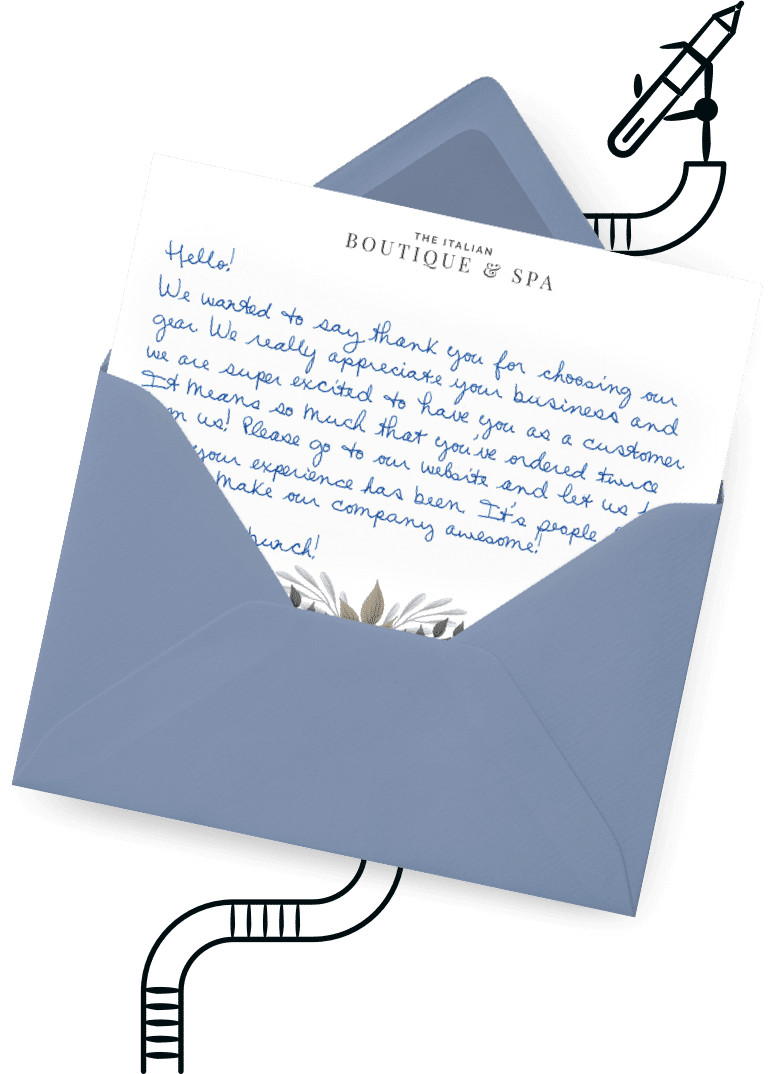

Over 100 designs to choose from or design your own. Our online card customizer makes it simple.
Check Out Our Cards!




Thank you.
