



In financial services, the advisor who feels most human wins the relationship — and keeps it through every market cycle.
Financial advisor thank you cards are one of the most consistently underleveraged relationship tools available in wealth management and financial planning — and one of the most consequential for the specific business outcomes that determine long-term practice success. Client loyalty in financial services isn’t built primarily on performance. It’s built on trust — and trust is built at the individual, human moments when an advisor communicates genuine care for the person behind the portfolio rather than the portfolio itself.
The advisors who retain clients through volatile markets, who generate referrals consistently rather than sporadically, and who build practices that grow through relationship depth rather than perpetual new client acquisition share a consistent characteristic: they invest in the human layer of the client relationship with the same deliberateness they invest in the financial layer. Financial advisor thank you cards are the most cost-effective investment in that human layer available — arriving in a physical format that no digital communication matches, at the moments that matter most in the client relationship lifecycle, communicating individual care in a way that sustains loyalty through the inevitable challenges that every long-term financial relationship encounters.
This guide covers exactly how financial advisor thank you cards build the trust and loyalty that sustain practices through market cycles, competitive pressure, and the generational wealth transfer that is reshaping every advisory relationship — with the specific touchpoints, messages, and implementation approach that produce the strongest results.
The financial services industry has a specific trust challenge that thank you cards are uniquely positioned to address. Clients entrust their financial futures to advisors — and that level of trust requires a depth of relational confidence that digital communication alone rarely sustains. An advisor who communicates primarily through emails, portal notifications, and quarterly statements is communicating competence. An advisor who adds genuine, physical, individually written thank you cards at the key moments in the client relationship is communicating something more than competence — care, individual attention, and the kind of human investment that clients remember when they’re deciding whether to stay through a difficult market period or refer a colleague to their advisor.
The research behind this is consistent: clients who leave financial advisors rarely cite performance as the primary reason. They cite feeling like a number, feeling like the relationship was transactional, feeling like they weren’t individually seen or valued beyond their account balance. Financial advisor thank you cards directly address every one of those departure drivers — arriving with no commercial agenda, in the most personal format available, at moments specifically chosen to communicate that the client is valued as an individual rather than managed as an account.
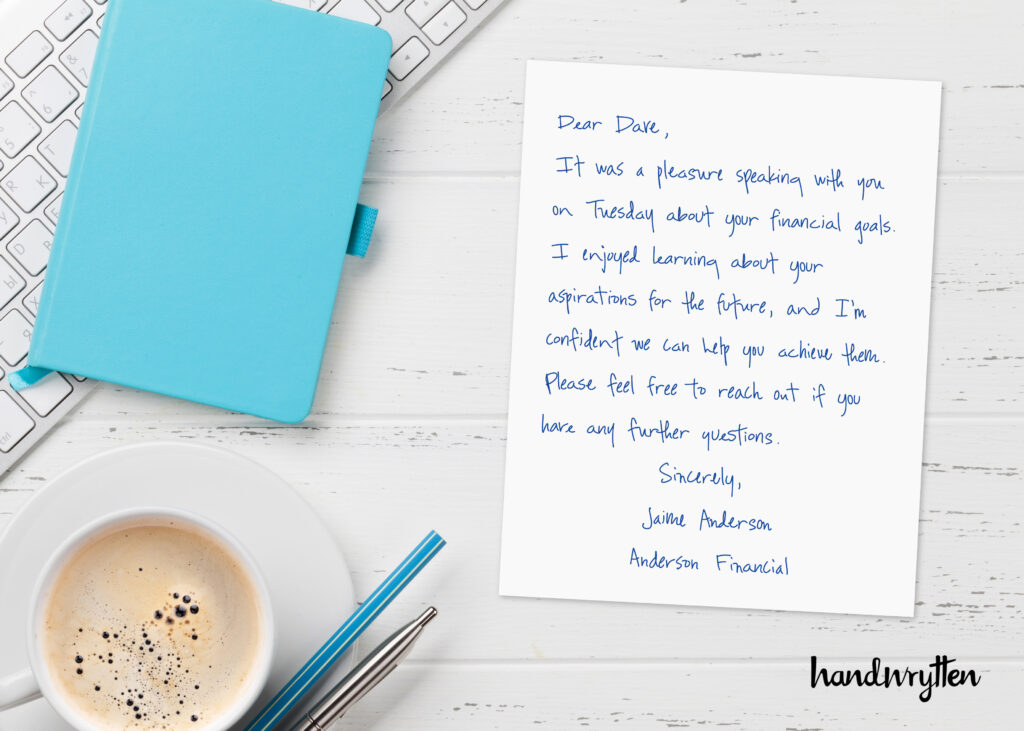
The first financial advisor thank you card that creates a lasting impression arrives within 48 hours of an initial consultation — before the prospective client has made their final advisor selection decision, while their impression of the advisor is still being formed.
Most financial advisors follow up an initial consultation with an email summarizing the conversation and outlining next steps. A genuine handwritten thank you card arriving at the same moment — acknowledging the conversation specifically and communicating genuine individual care — creates the first unexpected gesture of personal attention that differentiates the advisor from every competitor relying exclusively on digital follow-up.
The prospective client evaluating multiple advisors who receives a handwritten thank you card from one of them has a specific, memorable story — and a significantly different impression of that advisor’s character and attention to detail before the financial relationship has even formally begun.
What to write:
“[Name] — thank you for sharing your financial goals and concerns with me on [day]. That kind of trust takes time to extend, and I want you to know I don’t take it lightly. Whatever you decide about next steps, I genuinely enjoyed the conversation and am here for any questions.”
“Thank you for meeting with me — I found our conversation about [specific topic discussed] genuinely insightful and I’ve been thinking about it since. I’d be honored to work with you, and I wanted to make sure that came through in something more personal than a follow-up email.”
“[Name] — it was a genuine pleasure to meet you. The financial goals you shared are ones I believe we can help you reach — and I wanted to reach out personally to say thank you for considering our practice. I’m here for any questions as you think things through.”
The moment a new client signs on is the highest point of new client emotional receptivity in the entire advisory relationship — and the moment most advisors handle with an onboarding email and a document checklist. A financial advisor thank you card arriving two to three days after the relationship begins creates the first unexpected gesture of genuine individual acknowledgment that new client loyalty is built on.
The new client who receives a genuine handwritten welcome card from their financial advisor has a specific story to tell their colleagues, friends, and family members who ask how the new advisor relationship is going — and that story generates the organic word-of-mouth that the most effective advisor referral programs run on.
What to write:
“Welcome — and thank you for the trust you’ve placed in our practice. That trust is something I think about seriously, and I’m committed to earning it every day of our work together. I’m genuinely excited about what we’re going to build.”
“[Name] — it’s official, and I’m genuinely glad. Thank you for choosing to work with us. Your financial future is something I take seriously as a responsibility, and I wanted that to come through in something more personal than an onboarding email. I’m here for anything.”
“Thank you for choosing our practice — the decision to trust someone with your financial future is significant, and I don’t take it lightly. I look forward to everything we’re going to build together and wanted to say that directly before we get into the work.”
The most powerful financial advisor thank you cards are the ones that arrive at personal milestones — the moments in a client’s life that have financial implications but are fundamentally human experiences worth acknowledging as such. A new home, a retirement, the birth of a child or grandchild, a business sale, a significant anniversary — these moments are when clients are most emotionally attuned to how the people in their professional lives treat them.
The financial advisor who acknowledges these moments with a genuine handwritten card — warm, specific, and completely free of financial content — communicates something that sustains loyalty more reliably than any investment performance: that the relationship is valued as a human partnership rather than a commercial engagement.
What to write:
New home:
“Congratulations on the new home, [Name] — this is one of those milestones worth marking with something more than a text message. We’re so glad to have been part of the financial journey that made this possible. Here’s to everything the next chapter holds.”
Retirement:
“Congratulations on your retirement, [Name] — this is the moment we’ve been working toward together, and I want you to know how genuinely proud I am of what you’ve built. It has been a privilege to be your advisor through this journey. Enjoy every moment of what’s ahead.”
New grandchild:
“Congratulations on the arrival of [grandchild’s name] — what wonderful news. Being a grandparent is one of life’s great privileges, and we’re so happy for your whole family. What a beautiful addition.”
Business sale or significant professional milestone:
“Congratulations on the [sale/milestone] — this represents years of work and commitment, and I’m genuinely proud to have been part of the financial planning that supported it. Well done, [Name]. Here’s to everything the next chapter brings.”
Market volatility is the moment when client loyalty is most tested — and the moment when most advisors default to mass email communications that feel exactly as mass as they are. A genuine handwritten card from a financial advisor arriving during a period of significant market turbulence creates a completely different impression than a broadcast email, because the physical format communicates something the broadcast email never does: that this specific client was thought about specifically during the difficult market period.
Financial advisor thank you cards during market volatility should be warm, reassuring, and completely free of specific financial content or performance data — leaving those details for formal communications. The purpose of the card is to communicate individual human presence and steady confidence, not to provide a market update.
What to write:
“[Name] — I wanted to reach out personally during this period of market noise, rather than letting our next scheduled call be the first you heard from me. Your long-term plan was built for periods exactly like this one, and my confidence in your position hasn’t changed. I’m here for any questions or conversations whenever you’d like.”
“Markets move — sometimes dramatically, and sometimes in ways that feel alarming in the moment. I wanted to reach out as a person rather than through another email to say that I’m watching closely, I’m thinking about your specific situation, and I’m here for any conversation you want to have. Please reach out anytime.”
“[Name] — a quick personal note during a noisy market period. Nothing has changed in my thinking about your financial position, and I wanted you to hear that directly from me rather than through a broadcast update. I’m here whenever you want to talk.”
When a client refers someone to their financial advisor — the highest possible expression of trust and satisfaction available — that referral deserves immediate, specific, physical acknowledgment. The financial advisor thank you card that arrives within 24 hours of receiving a referral communicates genuine individual gratitude in a format that no email acknowledgment ever matches — and creates the impression that makes the referring client significantly more likely to refer again.
The referral thank you card is the single highest-return financial advisor thank you card investment available — because it directly acknowledges the behavior that generates the highest-quality new client leads while communicating the individual appreciation that sustains ongoing referral activity.
What to write:
“[Name] — thank you for referring [referred client name] to our practice. That kind of trust is the highest compliment I can receive, and I want you to know I take it seriously. We’re going to take excellent care of them — and I’m deeply grateful for your confidence.”
“Thank you for thinking of me when [referred client] needed financial guidance. A referral from a client like you is something I genuinely don’t take for granted. It means everything to know our work together has meant enough that you’d share it with someone you care about.”
“[Name] — I wanted to reach out personally to say thank you for sending [referred client name] our way. Your referral tells me more about the relationship we’ve built than any survey or review ever could. I’m deeply grateful and committed to honoring that trust.”
Long-term client relationships — the clients who have been with an advisor for five, ten, twenty years — represent the most valuable and most loyal segment of any financial practice. Financial advisor thank you cards acknowledging the tenure of these relationships, arriving with no commercial agenda at meaningful milestone moments, communicate the ongoing individual investment that sustains loyalty through competitive approaches, market challenges, and the natural drift that affects every long-term professional relationship.
What to write:
One-year anniversary:
“One year — and I’m genuinely grateful for it. Thank you for the trust you’ve placed in our work together over these first twelve months. I’m looking forward to everything the next year brings and wanted to make sure you knew that directly.”
Five-year milestone:
“Five years of partnership — that’s not a small thing, and I don’t treat it as one. Thank you for the continued trust and for the relationship we’ve built together. I’m genuinely proud of what we’ve accomplished and excited about everything ahead.”
Ten-year or longer:
“A decade of working together — I find myself genuinely moved by that when I think about it. Thank you for the trust, the patience, and the relationship we’ve built over these years. It’s one I value deeply and am committed to for everything ahead.”
Annual no-occasion appreciation:
“No particular occasion for this — just a genuine moment of appreciation for one of my most valued client relationships. Thank you for your continued trust. It means more than I express often enough.”
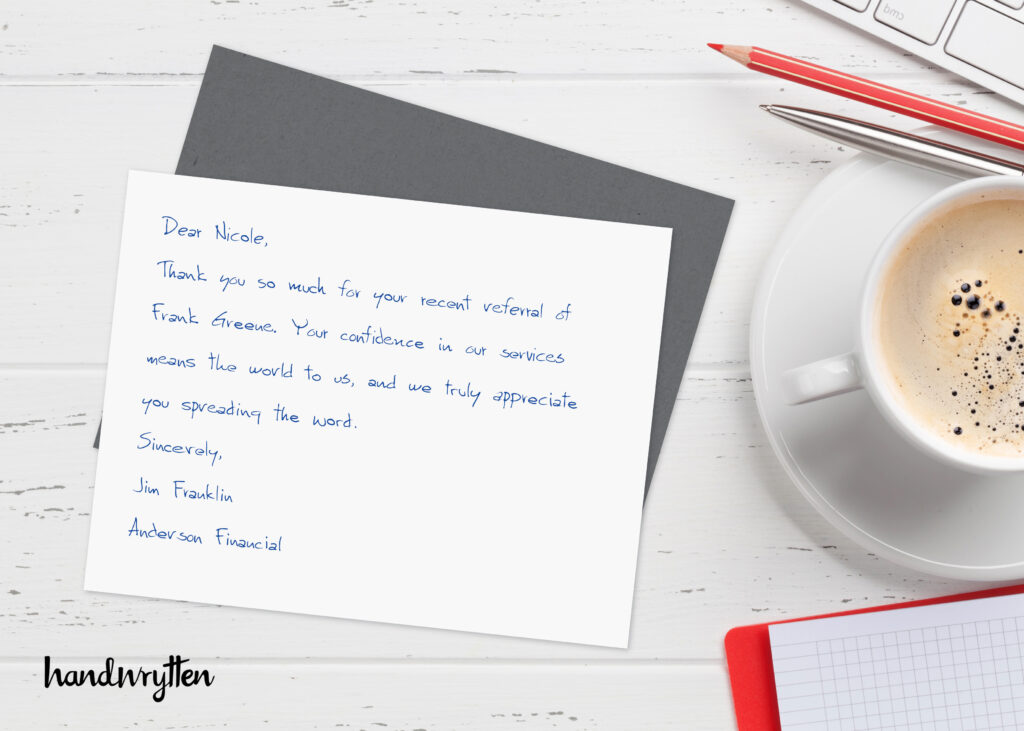
Custom branded stationery. Every financial advisor thank you card should reflect the practice’s professional visual identity — ensuring the physical card communicates the same level of professionalism as the advice itself. Handwrytten’s platform supports fully branded custom stationery with logos, colors, and typography that align with the practice’s established brand standards.
The advisor’s personal signature. Individual advisor signatures on client cards — recreated through Handwrytten’s signature service from a completed handwriting packet — communicate personal investment in the specific relationship rather than a generic practice acknowledgment. The card that looks like it came from the specific advisor who manages the client’s portfolio carries more relational weight than one that looks like it came from the practice generally.
Specific personalization. Every financial advisor thank you card should include the client’s name and at least one specific reference — to the conversation, the milestone, the referral, or the tenure — that makes the card feel written for this specific client rather than for anyone in the relevant demographic.
Thoughtful inserts when appropriate. For high-value relationship milestones — a client’s retirement, a significant anniversary, a major referral — a modest gift card inclusion communicates tangible appreciation that elevates the gesture beyond a warm card.
The most effective financial advisor thank you card programs aren’t the ones that happen when someone on the team remembers — they’re the ones built into the practice’s operational infrastructure so that every meaningful client relationship moment triggers the appropriate card automatically.
Trigger mapping in your CRM. Identify every key client relationship moment where a thank you card would create a strong impression — initial consultation completion, new client onboarding, milestone date fields, referral receipt, anniversary dates, market volatility periods. Configure each trigger in Salesforce, HubSpot, or your practice management platform to initiate a Handwrytten card send automatically.
Message templates by touchpoint. Develop message frameworks for each trigger category — warm enough to feel genuine, specific enough to feel individual, flexible enough to be personalized with the client’s name and specific relationship context through dynamic fields.
Handwrytten integration. Handwrytten’s integrations with Salesforce, HubSpot, Zapier, and other platforms used in financial advisory practices allow thank you cards to be triggered automatically at every mapped moment — each card produced in genuine pen-and-ink handwriting, personalized for the individual client, and mailed without any manual effort from the advisory team.
How quickly should financial advisor thank you cards be sent after key events?
Within 24 to 48 hours of the triggering event for maximum impact — while the positive feelings of the interaction are still fresh. Handwrytten’s one-to-two business day production turnaround ensures cards triggered immediately after a consultation, new client signing, or referral receipt arrive within the optimal window.
Can financial advisor thank you cards include compliance-sensitive content?
Financial advisor thank you cards should be kept warm and personal rather than financial in content — avoiding specific performance data, investment recommendations, or any content that would fall under regulatory review. Cards focused purely on relationship acknowledgment and genuine appreciation are well outside typical compliance concerns and require no special review.
Can thank you cards be personalized for each client at scale?
Yes. Handwrytten’s dynamic personalization system pulls client names, milestone specifics, and any other relevant data from CRM records into each card automatically — ensuring every card in a bulk send feels individually written for its specific recipient.
Can individual advisor signatures be included on thank you cards?
Yes. Handwrytten’s signature recreation service produces each advisor’s personal signature for use on every card — created from a completed handwriting packet and used exclusively on the practice’s account. Every card looks like it came directly from the specific advisor whose name appears on it.
How do financial advisor thank you cards integrate with practice management software?
Handwrytten integrates with Salesforce, HubSpot, Zapier, and other platforms commonly used in financial advisory practices — allowing thank you card triggers to be configured directly from client milestone fields, stage changes, and relationship events in existing systems.
Financial advisor thank you cards aren’t a soft marketing tactic — they’re a systematic investment in the human layer of client relationships that produces the specific business outcomes financial practices depend on: loyalty that sustains through difficult markets, referral behavior that drives new client acquisition without marketing spend, and the professional reputation that makes a practice the first recommendation when someone in a client’s network needs financial guidance.
The advisor who feels most human wins the relationship. The one who wins the relationship keeps it through every market cycle. And the one who keeps it builds the practice that compounds — in client loyalty, in referrals, and in the professional reputation that no amount of digital marketing ever replicates at the same depth.
Start Sending → handwrytten.com
Editor’s note: This article was revised in July 2026


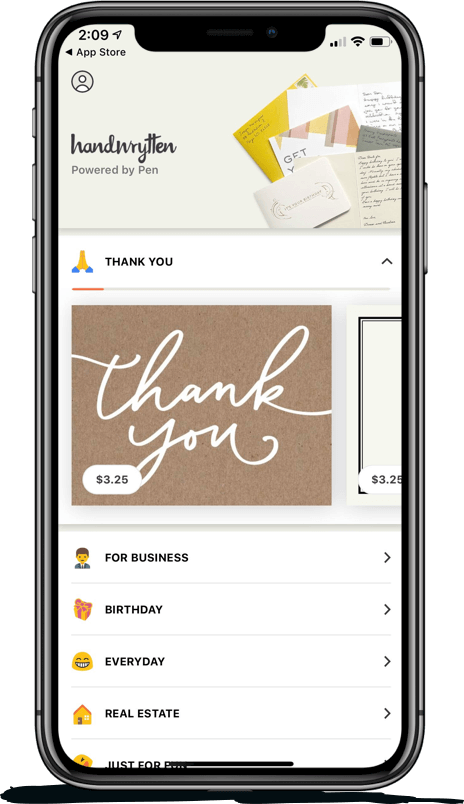
Scale your handwritten outreach, creating positive impressions and long lasting bond.
Sign Up Today!



Over 100 designs to choose from or design your own. Our online card customizer makes it simple.
Check Out Our Cards!




Thank you.
