



Two words — thank you — do more for a business relationship than most organizations ever leverage.
Business thank you cards are one of the highest-return, most consistently underleveraged tools in any organization’s relationship-building program — and the ones that separate businesses whose clients feel genuinely valued from those whose clients feel adequately served. The difference between those two outcomes is significant: clients who feel genuinely valued stay longer, spend more, and refer more actively than clients who feel adequately served. And the investment required to create that difference is often as simple as a handwritten thank you card arriving at the right moment.
Most businesses acknowledge the importance of expressing gratitude. Far fewer build systematic thank you card programs that deliver genuine, personal appreciation to every client, customer, employee, and partner who deserves it — consistently, at the right moments, in a format that creates lasting impressions. The nine rules in this guide cover everything you need to know to build a business thank you card program that actually works — from who should receive them and when, to what to write and how to make the gesture feel genuinely personal at any scale.
The most common mistake organizations make with business thank you cards is limiting them to a single audience — usually customers — while overlooking the full ecosystem of relationships that sustains the business.
Effective business thank you card programs acknowledge every meaningful relationship: customers and clients who generate revenue, employees and team members who deliver the work, business partners and suppliers who enable operations, professional contacts who refer opportunities, donors and volunteers who sustain nonprofit missions, and the new contacts whose relationships are still being established.
Each of these audiences represents a relationship worth investing in — and business thank you cards are the most cost-effective investment available in most of them. A supplier who receives a genuine handwritten thank you card from a business partner isn’t just appreciated — they’re more likely to prioritize that partner when capacity is constrained, more likely to offer favorable terms at renewal, and more likely to refer other business opportunities. The same dynamic applies across every audience: genuine individual appreciation communicated through a physical, handwritten card creates relational goodwill that sustains every dimension of the business ecosystem.
When to send business thank you cards across your ecosystem:
Customers and clients: After a first purchase or engagement, at loyalty milestones, after a significant project completion, and at seasonal moments throughout the year.
Employees: After exceptional performance, at work anniversaries, at year-end, and at personal milestones — birthdays, promotions, life events.
Business partners and suppliers: After contract renewals, following particularly strong collaboration, and at seasonal moments that acknowledge the ongoing partnership.
New contacts: After first meetings, following events or conferences, and whenever a new professional relationship is being established.
Donors and volunteers: After every contribution — financial or time-based — and at meaningful milestones throughout the giving relationship.
Understanding what business thank you cards actually accomplish — beyond the immediate expression of gratitude — is what builds the business case for systematic investment in them.
They build client loyalty. Clients who receive consistent, genuine thank you cards from the businesses they work with retain at significantly higher rates than those who receive only transactional communication. The mechanism is straightforward: people stay loyal to businesses that make them feel individually valued — and handwritten business thank you cards are the most reliable format for creating that felt sense of individual value.
They generate referrals. The reciprocity effect — the psychological principle that genuine, unexpected appreciation triggers advocacy — is most powerfully activated by physical, handwritten gestures. A client who receives a genuine handwritten thank you card experiences a quality of relational warmth that expresses itself naturally as referral behavior. Most businesses’ most loyal referral sources are also their most consistently acknowledged clients.
They communicate character. A business that sends genuine, personal, timely thank you cards communicates specific things about its character — that it pays attention to details, that it follows through on interactions, and that it values relationships independent of their immediate commercial utility. These qualities build the reputation that attracts the clients and partners worth having.
They generate positive word of mouth. Research consistently shows that consumers trust recommendations from people they know significantly more than any form of advertising. A client who feels genuinely valued by a business becomes an organic advocate — sharing their experience in conversations that no advertising budget can replicate.
Of all the rules for effective business thank you cards, personalization is the one that most directly determines whether a card creates a lasting impression or a pleasant one that fades within hours.
The science behind this is consistent and clear: people are neurologically wired to respond positively to individual acknowledgment. A thank you card that includes the recipient’s name, references a specific interaction or contribution, and communicates something genuine about the specific relationship creates a significantly stronger emotional impression than one that uses generic language that could apply to anyone.
The personalization elements that make business thank you cards memorable:
The recipient’s name. The simplest personalization available — and one of the most impactful. A thank you card that opens with the recipient’s name communicates individual attention from the first word.
A specific reference to the interaction. Mentioning the specific project, purchase, meeting, or contribution being acknowledged communicates that the sender noticed this specific thing — not just that a transaction occurred.
A personal detail when appropriate. A reference to something specific about the recipient — an upcoming project, a recent achievement, a known interest — communicates genuine individual care for the person behind the professional relationship.
Sample personalized business thank you card messages:
For a new client:
“[Name] — thank you for trusting us with [specific project]. We’re genuinely invested in making sure this delivers everything you were hoping for when you said yes. We’re glad you’re here.”
For a long-term client:
“[Name] — [X] years of partnership is something we don’t take for granted. Thank you for the continued trust you place in us. What we’ve built together is something we’re proud of.”
For an employee:
“[Name] — what you brought to [specific project] made a real difference to the outcome and to everyone around you. Thank you for the commitment and care behind it.”
In a business communication landscape dominated by email, automated sequences, and digital outreach, the handwritten thank you card is the format that creates the most disproportionately strong impression relative to its cost — because it arrives in a channel that no digital communication reaches, signals genuine individual effort before it’s opened, and creates the kind of lasting physical impression that digital messages almost never generate.
Research consistently demonstrates that handwritten communications are opened more frequently, read more carefully, and remembered more vividly than their printed or digital counterparts. Handwritten envelopes are opened at dramatically higher rates than printed ones. Physical mail generates emotional engagement that digital alternatives consistently fail to match.
For businesses, the practical challenge of deploying genuinely handwritten thank you cards at any meaningful scale is precisely where most programs fail — defaulting to printed cards or digital messages because the manual effort of writing individual cards for hundreds of clients isn’t operationally feasible. Handwrytten’s robotic pen-and-ink technology solves this problem entirely — producing genuinely handwritten business thank you cards in real pen on real paper, personalized for each individual recipient, at any volume, without any manual writing effort from your team.
The result is a business thank you card program that delivers the authentic quality of genuine handwritten communication at the operational efficiency that modern business requires.
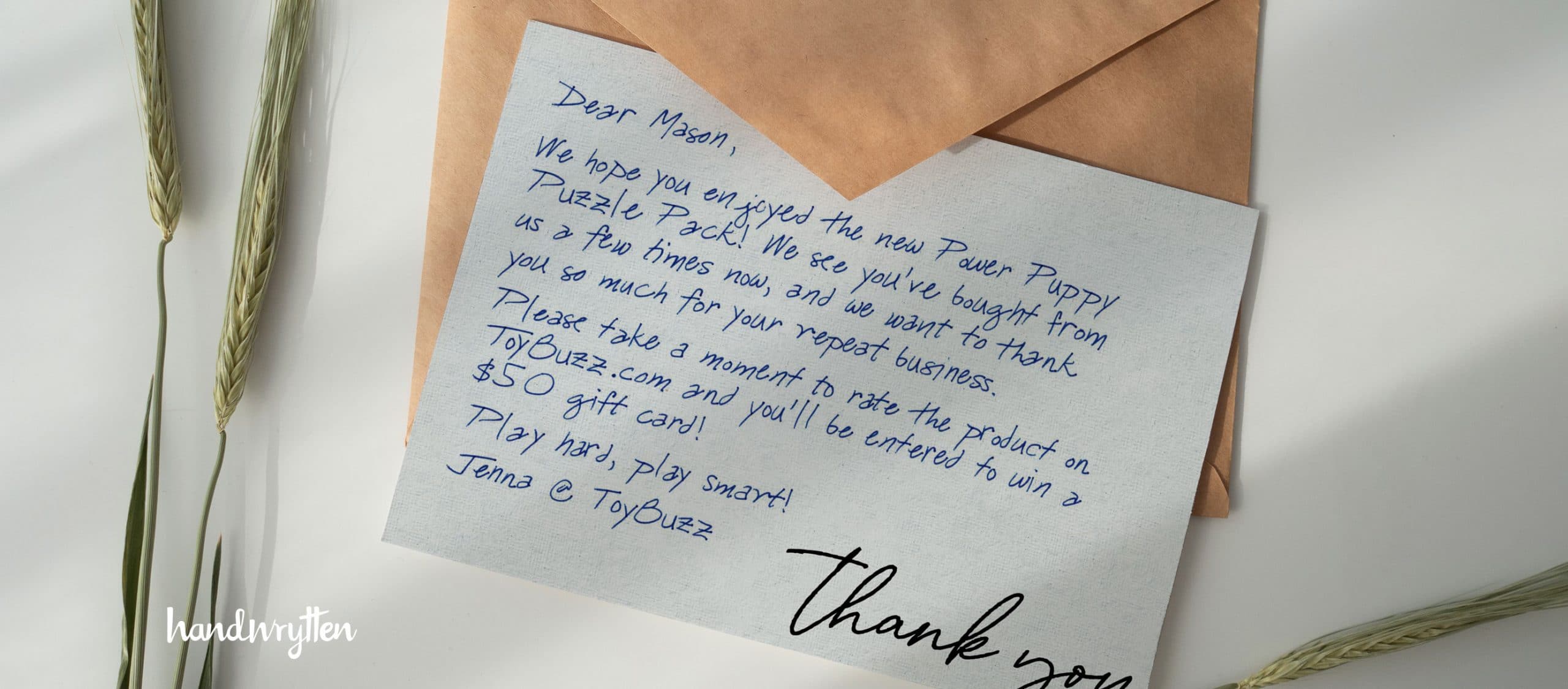
Knowing what to include in a business thank you card removes the friction that prevents most organizations from sending them consistently. The most effective business thank you cards follow a simple, consistent structure:
Opening — the greeting. Address the recipient by name. Depending on the relationship and your organization’s tone, this can be as simple as “[Name] —” or as warm as “Dear [Name].” Avoid generic openers like “To our valued customer” that immediately signal mass communication.
Body — the thank you itself. Express genuine gratitude for the specific thing being acknowledged — not general appreciation, but specific acknowledgment of what this person did, gave, or contributed. Keep the language warm but not excessive — genuine gratitude doesn’t require elaboration to be felt.
Personal touch — the detail that makes it individual. Where possible, include one specific detail that references the recipient’s specific situation, contribution, or relationship with your organization. This is the element that makes a business thank you card feel written for this person rather than for anyone in a similar situation.
Closing — the sign-off. Choose a closing that matches your organization’s tone and the nature of the relationship. “With gratitude,” “Warmly,” “Thank you again,” and “With genuine appreciation” all work well for business thank you cards. Avoid closings that feel impersonal or overly formal in contexts where warmth is appropriate.
A business thank you card sent promptly communicates that expressing gratitude is an organizational priority — not an afterthought managed when time permits. A card that arrives weeks after the interaction it’s acknowledging has lost most of its emotional relevance and communicates something the organization never intended: that the thank you was eventually remembered rather than immediately felt.
The timing guidelines that maximize business thank you card impact:
After a first purchase or meeting: Same day or next day — while the positive feelings of the new relationship are at their peak.
After project completion: Within 48 hours of delivery or closing — when the client’s satisfaction is freshest and their receptivity to acknowledgment is highest.
After a referral: Within 24 hours of learning about the referral — before the referring client has moved on to the next thing.
After an event or conference: Within 48 hours — while the interaction is still vivid and the new contact is still thinking about the conversations that came out of the event.
At recurring milestones: On or immediately before the milestone date — anniversaries, birthdays, and seasonal moments have the most impact when they arrive at the right time rather than approximately near it.
Handwrytten’s automated mailing capabilities allow business thank you cards to be triggered immediately when the relevant event occurs — ensuring every card arrives within the optimal window without any manual initiation from your team.
The business thank you card that includes a brochure, a coupon, a promotional insert, or a sales call to action has converted a genuine expression of gratitude into a marketing piece — and recipients feel that conversion clearly. The commercial content doesn’t enhance the thank you. It undermines it.
The value of a business thank you card comes precisely from its agenda-free quality — the fact that it arrives with no commercial purpose, no ask, and nothing to promote beyond the genuine appreciation it communicates. That agenda-free quality is what creates the relational warmth that produces loyalty and referral behavior. Commercial content — however modest — signals that the appreciation was instrumental rather than genuine.
This doesn’t mean business thank you cards can’t acknowledge the relationship’s commercial dimension — “your loyalty means a great deal to us” is appropriate. What it means is that the card should never include anything that makes the recipient feel they’re being marketed to rather than genuinely thanked.
The one exception: A small, thoughtful gift addition — a gift card to a coffee shop, a local treat, a modest seasonal item — communicates generosity rather than promotion when it accompanies a genuine thank you message. Handwrytten supports gift card inclusions at checkout, making it simple to pair a handwritten business thank you card with a tangible expression of appreciation without adding any promotional content.
The organizations that build the most effective business thank you card programs are the ones that systematize them — ensuring every meaningful interaction in every important relationship triggers the appropriate acknowledgment, regardless of how full the calendar is or how many other priorities are competing for attention.
A systematic approach to business thank you cards requires three elements:
Trigger identification. Map every meaningful event across your business ecosystem to a specific thank you card trigger — a new client CRM entry, a purchase event, a project completion milestone, an employee anniversary date, a donation receipt. The trigger is what makes the system automatic rather than dependent on someone remembering.
Message templates by relationship and occasion. Prepare message frameworks for each major thank you card category — new client welcome, post-purchase appreciation, project completion, referral acknowledgment, employee recognition, donor stewardship — specific enough to feel genuine, flexible enough to be personalized automatically.
Automation through Handwrytten. Handwrytten’s integrations with Salesforce, HubSpot, Shopify, Zapier, and other platforms allow business thank you cards to be triggered automatically at every meaningful moment — each one produced in genuine pen-and-ink handwriting, personalized for the individual recipient, and mailed without any manual effort from your team.
The result is a business thank you card program that runs consistently in the background — reaching every person at every meaningful moment, creating the relational impressions that sustain loyalty and generate referrals, without requiring any ongoing manual effort from the people responsible for delivering the work that earns the gratitude.
The single biggest barrier to consistent business thank you card programs isn’t budget, and it isn’t technology — it’s the combination of perfectionism and time pressure that causes most organizations to delay, revise, and ultimately not send the card that would have made a real difference.
A genuine, warmly worded thank you card that arrives promptly creates a significantly stronger impression than a perfectly crafted one that arrives late — because timeliness is itself a communication. It communicates that saying thank you is an organizational priority, not a task managed when time permits.
The practical implication is straightforward: build the system, prepare the templates, configure the automation, and let the cards go. The imperfect card sent consistently outperforms the perfect card sent occasionally in every measurable outcome — retention, referrals, loyalty, and the organizational reputation that sustains long-term business success.
New client welcome:
“Welcome — and thank you for choosing us. The trust you’ve placed in us with this engagement is something we take seriously and are committed to earning every day. We’re genuinely glad you’re here.”
Post-purchase:
“Thank you for your order — and for the confidence that comes with it. We hope [product/service] exceeds every expectation. We’re here for anything you need.”
Project completion:
“[Project] is complete — and we’re proud of what we built together. Thank you for your trust, your engagement, and the quality of partnership you brought to every step of the process.”
Referral acknowledgment:
“Thank you for sending [referred name] our way. That kind of trust is something we genuinely don’t take lightly — and we’re going to take excellent care of them. Thank you.”
Employee recognition:
“What you brought to [specific project or situation] was exceptional — and we wanted to make sure you heard that directly. Thank you for the commitment and care behind it. Well done.”
Donor acknowledgment:
“Thank you for your gift to [Organization]. What you’ve made possible is [specific impact] — and we’re genuinely grateful for the trust you’ve placed in this mission.”
Long-term client appreciation:
“[X] years of partnership — and we’re more grateful for it now than when it began. Thank you for the continued trust you place in us. It means more than a standard email can express.”
Seasonal appreciation:
“As [season] arrives, we wanted to take a moment to say thank you — specifically and genuinely — for the relationship we’ve built. It’s one we value deeply. Wishing you a wonderful [season].”
The operational challenge of sending genuine, personalized, handwritten business thank you cards consistently — across every client, every employee, every partner, and every meaningful interaction — is precisely what prevents most organizations from building the programs their relationships deserve.
Handwrytten removes that barrier entirely. Using robotic pen-and-ink technology that produces genuinely handwritten business thank you cards — real pen, real paper, real ink, with the natural variation that makes handwriting look and feel authentic — Handwrytten makes it possible to send personalized thank you cards at any volume without any manual writing effort.
Dynamic personalization fields pull recipient names, relationship context, and specific interaction details into each card automatically. Custom handwriting fonts built from your own handwriting mean every card looks like it came directly from you. Branded stationery ensures every piece reinforces your organization’s identity while communicating the genuine personal care that makes business thank you cards effective.
How often should businesses send thank you cards?
At every meaningful interaction — and the definition of meaningful should be broad. First purchases, project completions, referrals, employee milestones, donor contributions, and significant partnership moments all qualify. The organizations that see the strongest loyalty and referral outcomes from their business thank you card programs are the ones that err toward more rather than fewer.
What’s the right format — email or physical card?
Physical, handwritten cards create stronger and more lasting impressions than digital alternatives — consistently and across every demographic. Email has its place for operational communication. For the moments where genuine individual appreciation matters, a physical handwritten card outperforms every digital alternative.
How long should a business thank you card message be?
Three to five sincere sentences is the optimal length — long enough to communicate genuine individual acknowledgment, short enough to feel personal rather than formal. Trust the handwritten format to carry emotional weight and let the message stay focused on what actually matters.
Can business thank you cards be automated without losing authenticity?
Yes. Handwrytten produces genuinely handwritten cards — real pen on real paper — triggered automatically through CRM integrations, with each card personalized for the individual recipient. The automation handles the consistency and scale. The genuine handwriting and individual personalization handle the impression.
Should business thank you cards include a gift?
A modest, thoughtful gift addition — a gift card, a small treat, a seasonal item — can elevate the gesture when the relationship warrants it. Handwrytten supports gift card inclusions at checkout. The key is keeping any gift addition modest and genuinely thoughtful rather than promotional.
Business thank you cards are two words — thank you — delivered in the format that creates the most lasting impressions available in any relationship-building program. The rules above aren’t complicated. They’re consistent: send them to everyone who deserves them, personalize them with something real, make them handwritten, send them promptly, keep them genuine, and build the system that ensures no meaningful moment goes unacknowledged.
The businesses that follow these rules consistently are the ones whose clients feel genuinely valued. And clients who feel genuinely valued are the ones who stay, spend more, and tell others.
Start Sending → handwrytten.com


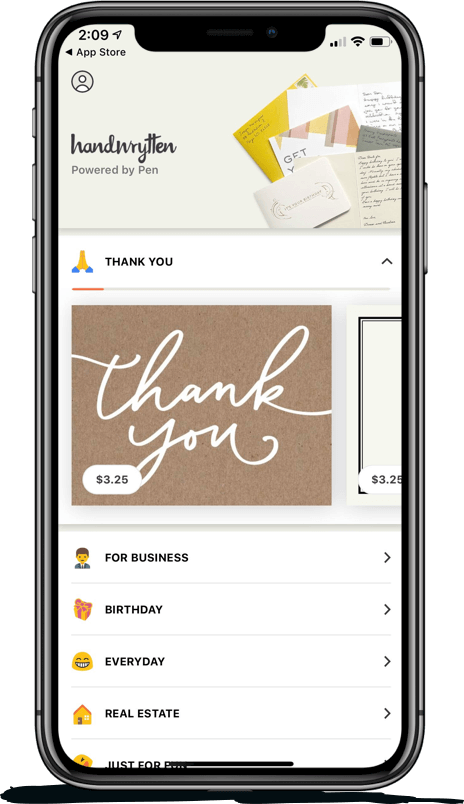
Scale your handwritten outreach, creating positive impressions and long lasting bond.
Sign Up Today!



Over 100 designs to choose from or design your own. Our online card customizer makes it simple.
Check Out Our Cards!




Thank you.
